
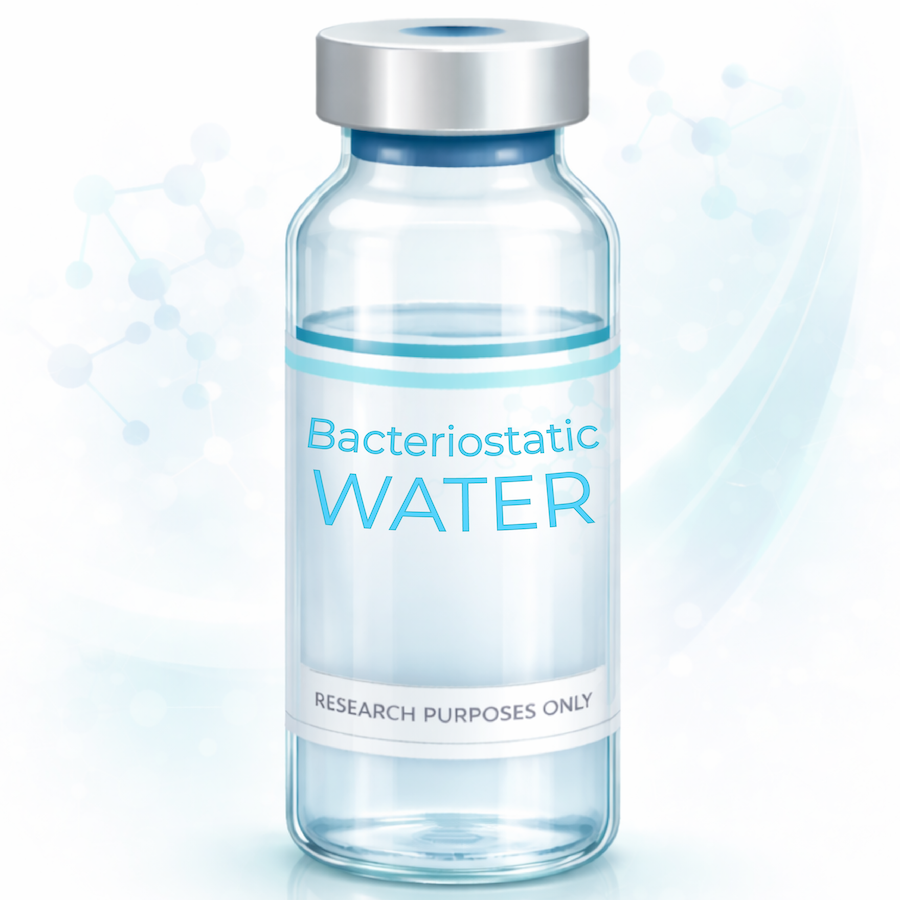
Description
Bacteriostatic Water (0.9% Benzyl Alcohol)
Chemical Classification: Sterile Preparation / Bacteriostatic Diluent
Chemical Composition: Sterile Water for Injection, 0.9% Benzyl Alcohol
Bacteriostatic Water is a sterile, non-pyrogenic preparation of distilled water containing 0.9% of benzyl alcohol added as a bacteriostatic preservative. In laboratory and biochemical research, it is classified as a reconstitution diluent. It is specifically designed for the repeated withdrawal of contents from a multi-dose vial, as the benzyl alcohol inhibits the growth of most potentially contaminating bacteria. This makes it an essential reagent for preserving the structural integrity and sterility of lyophilized peptides throughout the duration of a study.
Common Research Applications
This bacteriostatic preparation is utilized in laboratory models to investigate the following experimental objectives:
- Peptide Reconstitution: Serving as the primary solvent for lyophilized (freeze-dried) proteins and peptides to return them to a liquid state for in-vitro analysis.
- Multi-Dose Stability Studies: Research focusing on the long-term stability of specialized ligands when exposed to repeated atmospheric entry (vial punctures) over a 28-day period.
- Solubility & Homogeneity Assays: Investigations into the dissolution rates of various synthetic compounds and the maintenance of a homogenous solution for precise micro-dosing in experimental models.
- Microbial Inhibition Testing: Studies regarding the efficacy of 0.9% benzyl alcohol in preventing the proliferation of Gram-positive and Gram-negative bacteria in aqueous environments.
- pH-Sensitive Ligand Research: Utilization as a vehicle for peptides that require a slightly acidic environment (pH 4.5-7.0) to maintain molecular folding and prevent rapid hydrolysis.
Laboratory Handling & Storage
- Appearance: Clear, colorless, odorless liquid.
- Stability: The bacteriostatic preservative (benzyl alcohol) remains effective for 28 days following the initial breach of the vial seal.
- Storage: Store at controlled room temperature (20°C to 25°C). Protect from freezing and excessive heat. Ensure the vial stopper is sanitized with 70% isopropyl alcohol before every research-related withdrawal to maintain the integrity of the bacteriostatic environment.