
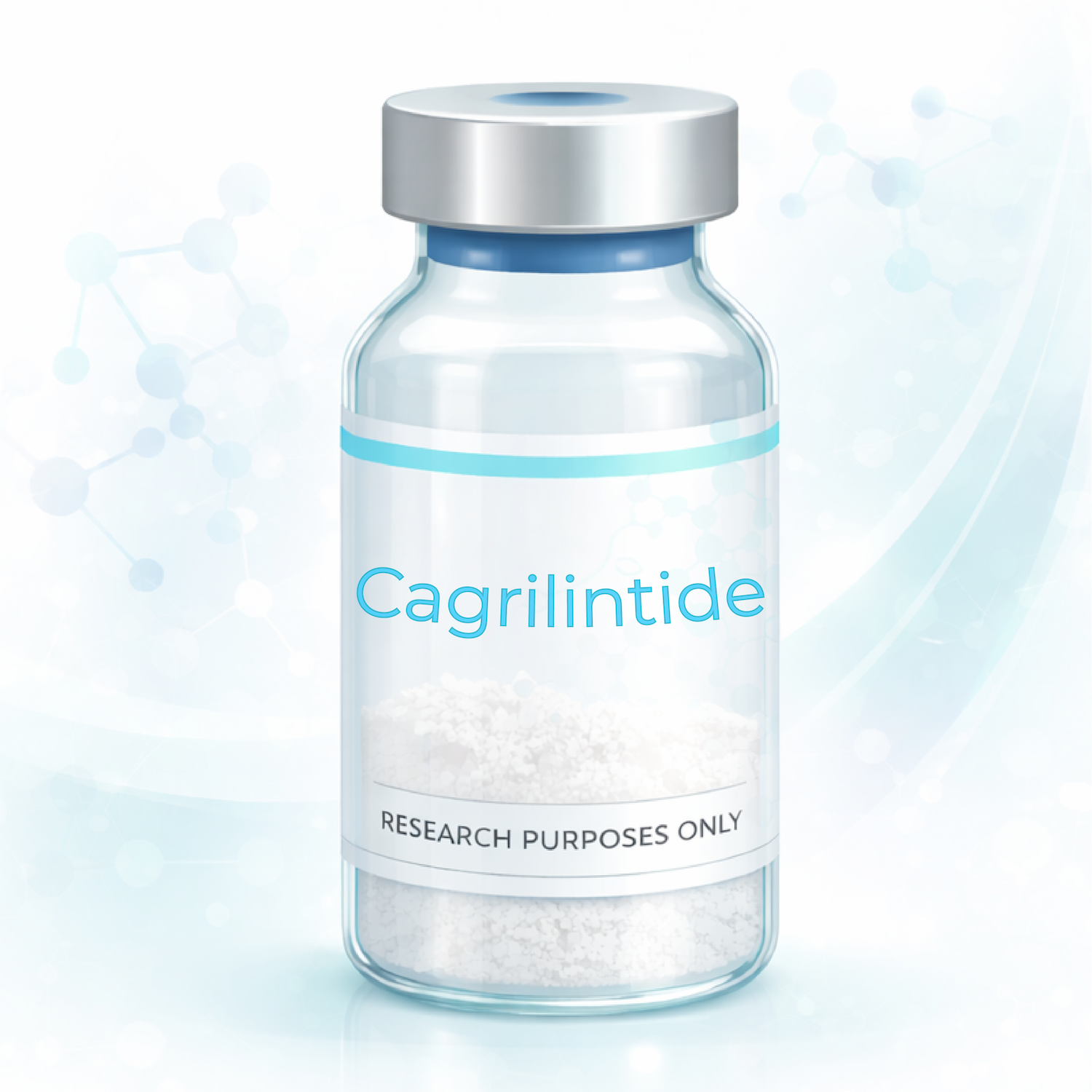
Description
Cagrilintide
Chemical Classification: Long-Acting Amylin Analog
Research Overview
Cagrilintide is a synthetic, acylated analog of the naturally occurring pancreatic hormone amylin. In biochemical research, it is classified as a non-selective amylin receptor agonist (RAMP-1, -2, and -3). It is specifically engineered with a fatty acid side chain to extend its half-life by enabling reversible binding to albumin. Cagrilintide is a primary subject in studies exploring the synergistic regulation of energy balance when investigated alongside GLP-1 receptor agonists, focusing on its ability to induce satiation through pathways distinct from the incretin system.
Common Research Applications
This amylin mimetic is frequently utilized in laboratory models to investigate the following experimental objectives:
- Dual-Agonism Synergy: Research focusing on the co-administration of Cagrilintide with Semaglutide to observe additive effects on weight homeostasis and metabolic rate.
- Gastric Emptying Kinetics: Investigations into the peptide’s role in delaying gastric emptying and modulating postprandial glucose absorption.
- Satiety Pathway Modulation: Studies regarding the activation of the area postrema and the nucleus tractus solitarius (NTS) in the hindbrain to investigate non-hypothalamic appetite control.
- Glucagon Suppression: Research observing the peptide’s ability to inhibit nutrient-stimulated glucagon secretion from pancreatic alpha cells.
- Adipose Tissue Metabolism: Exploration of the peptide’s influence on lipid metabolism and the potential reduction of ectopic fat storage in metabolic research models.
Laboratory Handling & Storage
- Appearance: Lyophilized white powder.
- Solubility: Highly soluble in bacteriostatic water, or sterile saline.
- Stability: Stable at room temperature for transit. For long-term preservation, the lyophilized powder must be stored at -20°C. Once reconstituted, the solution is sensitive to mechanical agitation.