
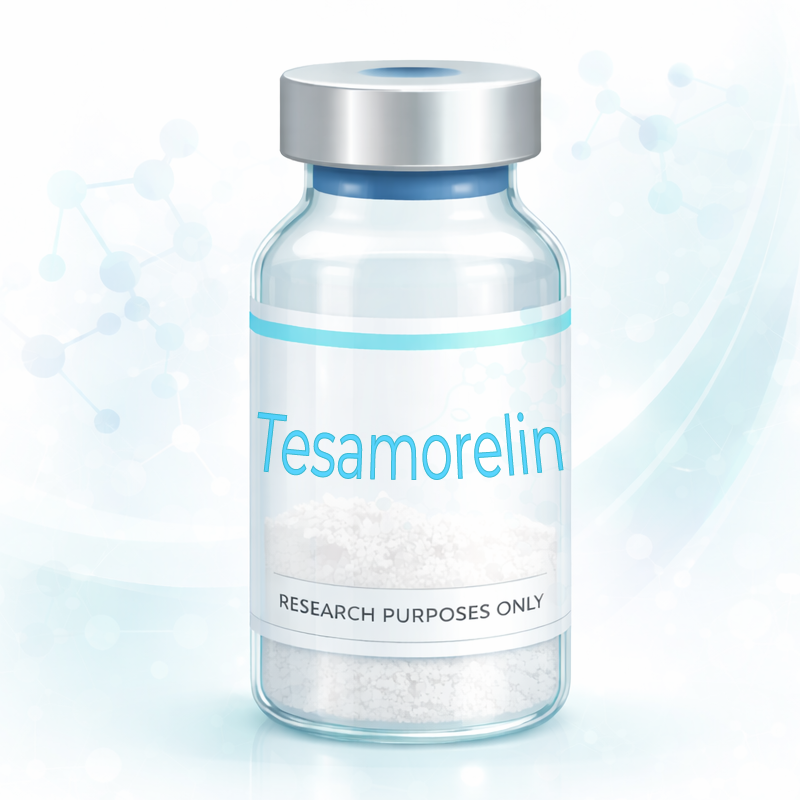
Description
Product Description: Tesamorelin
Chemical Classification: N-terminal Stabilized Growth Hormone-Releasing Hormone (GHRH) Analog
Research Overview
Tesamorelin is a synthetic 44-amino acid peptide analog of human Growth Hormone-Releasing Hormone (GHRH), modified by attaching a trans-3-hexenoic acid group to its N-terminus. In biochemical research, it is classified as a highly stable somatotropic secretagogue. The N-terminal modification provides enhanced structural resistance against enzymatic degradation by dipeptidyl peptidase-4 (DPP-4) relative to native GHRH(1-44). Tesamorelin is a primary subject in research evaluating the selective reduction of visceral adipose tissue (VAT), the clearance of intrahepatic lipid accumulation (hepatic steatosis), and the stimulation of natural, pulsatile growth hormone (GH) release without significant disruption to glucose homeostasis.
Common Research Applications
This stabilized GHRH analog is frequently utilized in laboratory models to investigate the following experimental objectives:
- Visceral Adiposity & Ectopic Lipid Mobilization: Research focusing on lipolysis within visceral fat depots and the reduction of intrahepatic triglycerides in non-alcoholic fatty liver disease (NAFLD) models.
- DPP-4 Resistance Mechanics: Investigations evaluating how the trans-3-hexenoic acid extension preserves structural integrity against rapid cleavage enzymes in biological media.
- Pulsatile Somatotropic Signaling: Studies evaluating pituitary GHRH receptor binding and the preservation of endogenous negative feedback loops during secretagogue exposure.
- IGF-1 Axis Elevation: Research assessing downstream hepatic synthesis of Insulin-like Growth Factor 1 (IGF-1) and its subsequent influence on tissue regeneration and cellular maintenance.
- Cardiovascular & Inflammatory Biomarkers: Exploration of the peptide’s influence on carotid intima-media thickness, C-reactive protein (CRP), and systemic lipid transport markers.
Laboratory Handling & Storage
- Appearance: Lyophilized white powder.
- Solubility: Soluble in sterile bacteriostatic water or phosphate-buffered saline (PBS).
- Stability: Highly stable in lyophilized form. Powder must be stored at -20°C for long-term preservation. Protect from light exposure.